
Santa Ana City Directory Years
Santa Ana city directories survive as a verified set of used volumes and local research citations, not as a single complete online run. The strongest year evidence comes from the HABS bibliography and Santa Ana historic-resource reports. Those sources document editions used by researchers, while the official Santa Ana History Room collections inventory describes the shelf more broadly as “City Directories of Orange County.”
| Collection | Verified years | Where held or cited | Access |
|---|---|---|---|
| Santa Ana and Orange County city directories | 1901, 1905, 1910, 1913-14, 1915, 1916-17, 1918, 1920, 1922-29, 1931-33, 1935-41, 1945, 1947, 1954, 1962 | History Room, local reports, HABS bibliography | In person; verify each volume |
| City directories used in the Freeman report | 1949-1960 | Santa Ana historic-register documentation | Research citation; confirm shelf copy |
| Criss-cross directories | 1980-1998 | History Room and a City report | Address-first; entries may be blank |
| Later directory evidence | 1999-2008 | Freeman Street report and local collection references | Later owner or occupant evidence |
| Sanborn fire-insurance maps | 1885-1949, with later local editions cited | Library of Congress and local reports | Free map images; not a people index |
The year list is deliberately precise. It does not claim a complete publisher list, a full shelf run, or a digitized directory catalog. Publisher names, reverse-directory holdings, telephone-book years, and a page scan should be confirmed with the History Room at SAHR@santa-ana.org. That honest gap changes the first research step: ask staff which volume is actually available before assuming that a missing year was never printed.
Santa Ana Directory Access Points
The Santa Ana History Room is the local doorway for directories, newspapers, photographs, microfiche, maps, yearbooks, and Orange County census material for 1860-1910. It lists extensive Santa Ana High School yearbooks plus smaller Valley, Century, Middle College, Saddleback, and Mater Dei runs. Reconfirm current hours and appointments; questions go to SAHR@santa-ana.org.
Newspapers fill thin directory years: Santa Ana Standard Weekly 1883-1893, Weekly Blade 1888-1892, Evening Blade 1891-1918, Leader 1901-1903, Santa Ana Register 1906-1955, The Register 1955-1985, and Orange County Register 1985-2009. The online Register database starts in 1987, overlapping the microfilm.
The Orange County Archives at 211 W. Santa Ana Boulevard holds historic property and vital material, county collections, maps, photographs, directories, and newspapers. It is open weekdays 8:00 a.m. to 4:30 p.m., closing noon to 1:00 p.m. The History Room inventory is the best lead-in to the collection image below.
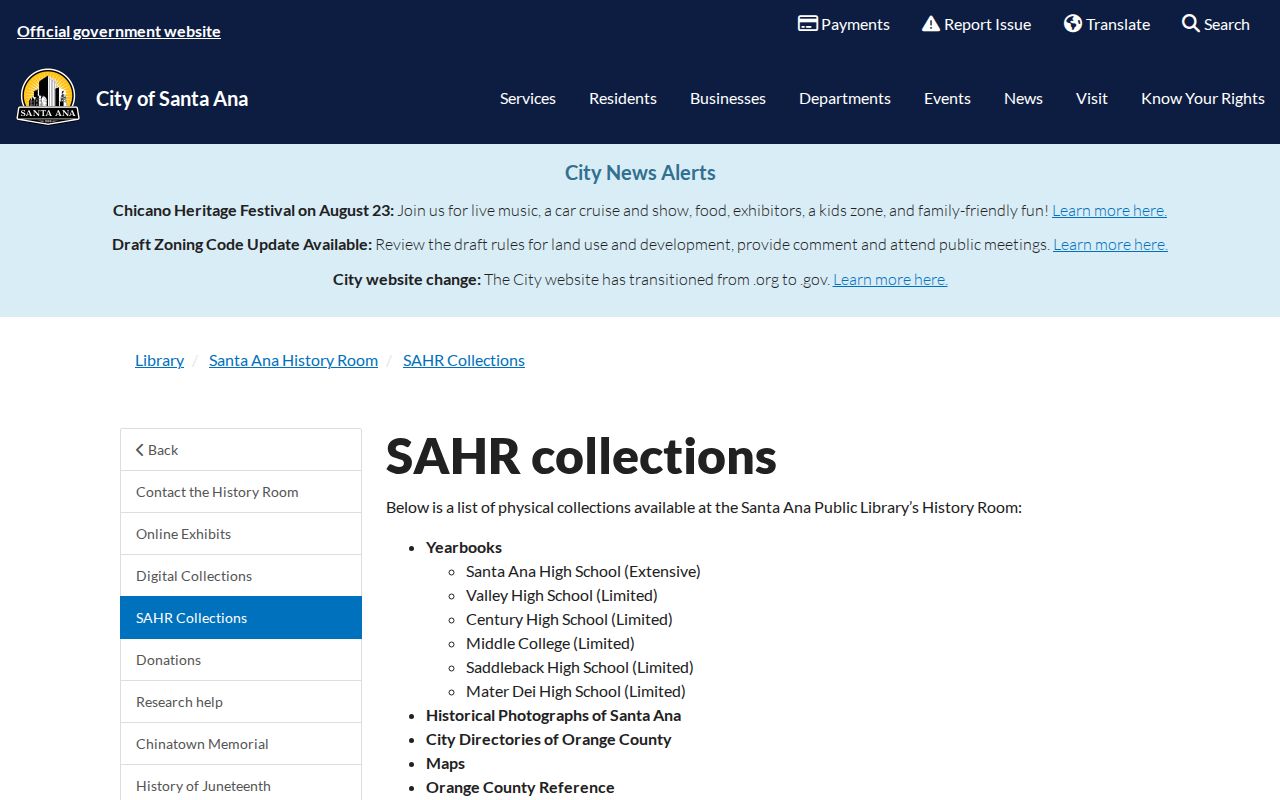
The image points to a real holdings inventory, but it does not turn the broad collection label into a promise that every year or publisher is on the shelf.
The Santa Ana History Room gateway adds the local mission and collection context behind the directory shelf.
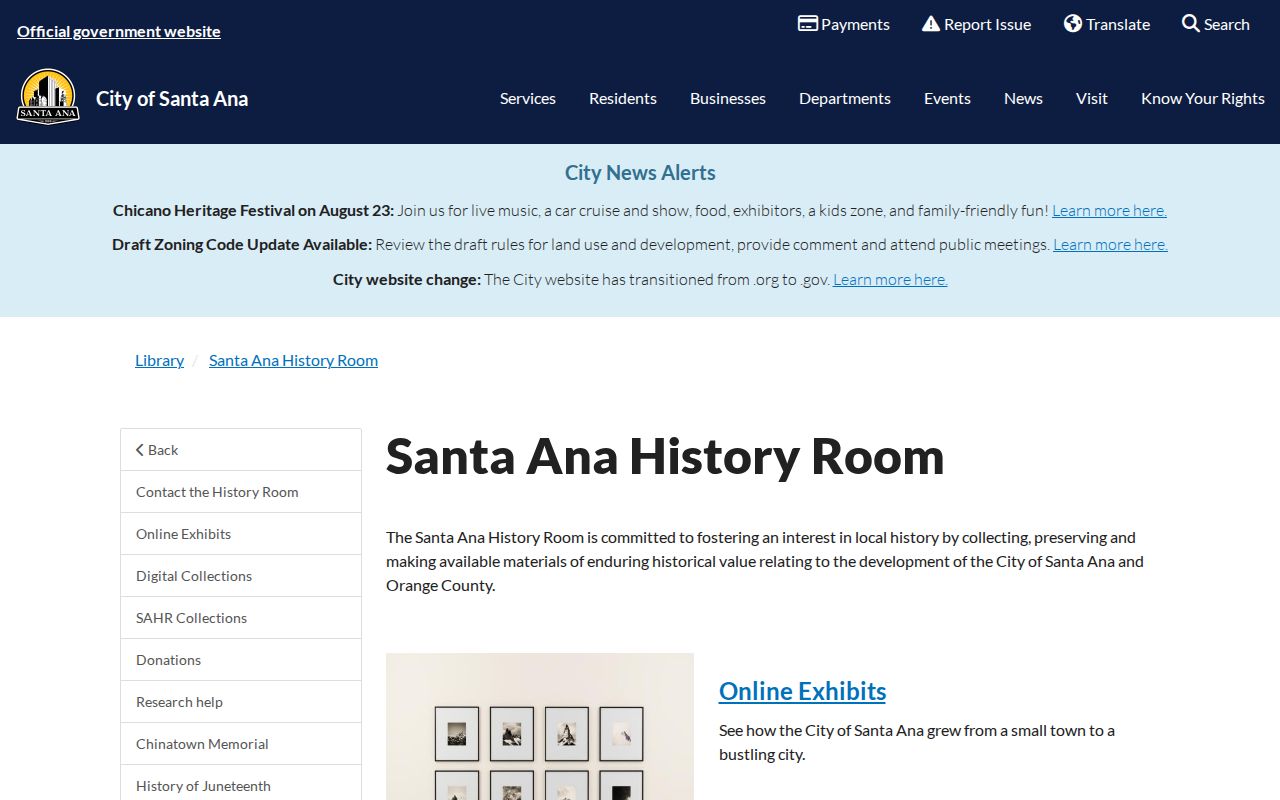
That access point helps place a directory request with the right local-history custodian before a visit.
Reading a Santa Ana City Directory
A Santa Ana city directory entry is a compact record, not a modern profile. An alphabetical listing may add an address, occupation, employer, spouse, or mark that separates one household from another. A reverse or criss-cross section starts with the address. Copy the entry before interpreting shorthand; old type can turn initials and punctuation into false name changes.
| Name | Head of household, spouse notation, initials, honorifics, or a widow form. |
|---|---|
| Occupation or affiliation | A trade, employer, office, or business clue when the volume supplies one. |
| Address | House number and street, sometimes with a residence or boarding abbreviation. |
| Owner or renter mark | Some runs distinguish ownership or rental status; confirm the volume's symbol key. |
| Household link | Spouse, co-resident, or nearby entry that helps test identity. |
- Criss-cross directory
- An address-first section or volume that lets a researcher start with a street number instead of a person's surname.
- Householder index
- A list arranged around the main household entry. It may omit boarders, children, renters, or other people at the same address.
- Abbreviation key
- The volume's explanation of short forms and marks. Find it before reading “r,” “b,” widow notation, or an owner symbol as a fact.
Santa Ana names require care. Spanish compound surnames, omitted accents, married-name conventions, initials, Anglicized given names, and Vietnamese name order can split one family across entries. Keep both surnames, search variants, and use an address, spouse, occupation, or census household as a second anchor.
501 E. Fifth Street Through Directories
Santa Ana's 501 E. Fifth Street example shows why a city directory is best read as a sequence. The compiled HABS and historic-register evidence separates owners from occupants and follows the address through multiple editions. The recorded sequence is Mary Whitson in 1905; Robert A. Wells of Wells Fargo Co. in 1908-1909; LeRoy Whitson and Mrs. Mary Whitson in 1910-1911; Mrs. Mary Whitson in 1912-1920; J. A. Powelson in 1922-1926; Fernand Pascal in 1927-1928; J. A. Powelson in 1929-1940; Mrs. A. D. Powelson in 1950-1962; and V. W. Powelson with C. J. Cummings in 1962.
The sequence combines an occupant, co-resident, employer, long run, and name-form change. It still does not prove ownership or account for every household member. A directory year is a clue; deeds, permits, census pages, and newspapers answer different questions. The HABS bibliography checks the cited directory and Sanborn years without claiming a complete digital run.
Santa Ana City Directory Gap
The 1961-1979 gap is one of the most important facts in the Santa Ana city directory record. A 2023 historic-resource report states that city directories supported 1949-1960 research, that directories were unavailable for 1961-1979, and that criss-cross volumes took over for 1980-1998. Treating that gap as a personal move would turn missing source material into an invented life event.
During a gap, change channels. Archives supply county context; permits date alterations; deeds show transfers; newspapers may carry an obituary, sale, civic role, or business notice; and a census household bridges public years through 1950. Keep a log marked found, unavailable, not checked, or silent. “Silent” means the volume was inspected but did not name the person or household.
Santa Ana Criss-Cross Directory Run
Santa Ana criss-cross directories cover 1980-1998 in the documented Freeman Street research. Their address-first design makes them valuable after alphabetical city directory entries thin out. Yet the same report found the subject address without an occupant or owner name. In other words, a listed address proves that the publisher recognized the location, not that the page contains a complete household.
Read each address-first result beside a deed, permit, or assessor record. Compare street spelling and number format. If the entry is blank, do not fill it with a nearby name. The next useful source may be a recorded instrument, a permit applicant, a tax mailing clue, a newspaper notice, or a later directory.
Research cue. A blank criss-cross entry is a result worth recording. It tells the researcher when to change sources instead of repeating the same failed name search.
Later Santa Ana Directory Evidence
The report identifies later directory evidence from 1999 through 2008, with 2008 the last volume used in that project. It is a useful endpoint, not proof of a full annual run or digital catalog. Confirm the volume and source note with the History Room. For current address work, use the Santa Ana Street Directory; for a modern identity check, use the Santa Ana resident lookup.
Santa Ana grew from William H. Spurgeon's 1869 townsite, while Orange County formed in 1889. Early entries may sit in a predecessor-county context. French Park and Heninger Park invite early map and directory work; postwar areas may need later volumes, tract records, permits, and parcel sources.
Sanborn Maps and Santa Ana Directories
Sanborn maps strengthen a Santa Ana city directory search with building footprints, use, street names, and number context. The Library of Congress volume covers 1906 through August 1949; local reports cite 1885, 1887, 1888, 1891, 1895, 1925, and 1949 editions, plus later site-specific editions.
A map is not a resident list. Pair it with a directory, census page, permit, or deed. For an old number, use cross streets, lot and block language, legal descriptions, and parcel history instead of guessing. The History Room's digital collections add place evidence: Elsa Edwards has more than 200 house and commercial images; Swanner, Cochems, and WPA Project 3105 document different growth eras. These images corroborate place, not identity. The digital collections show the relationship.
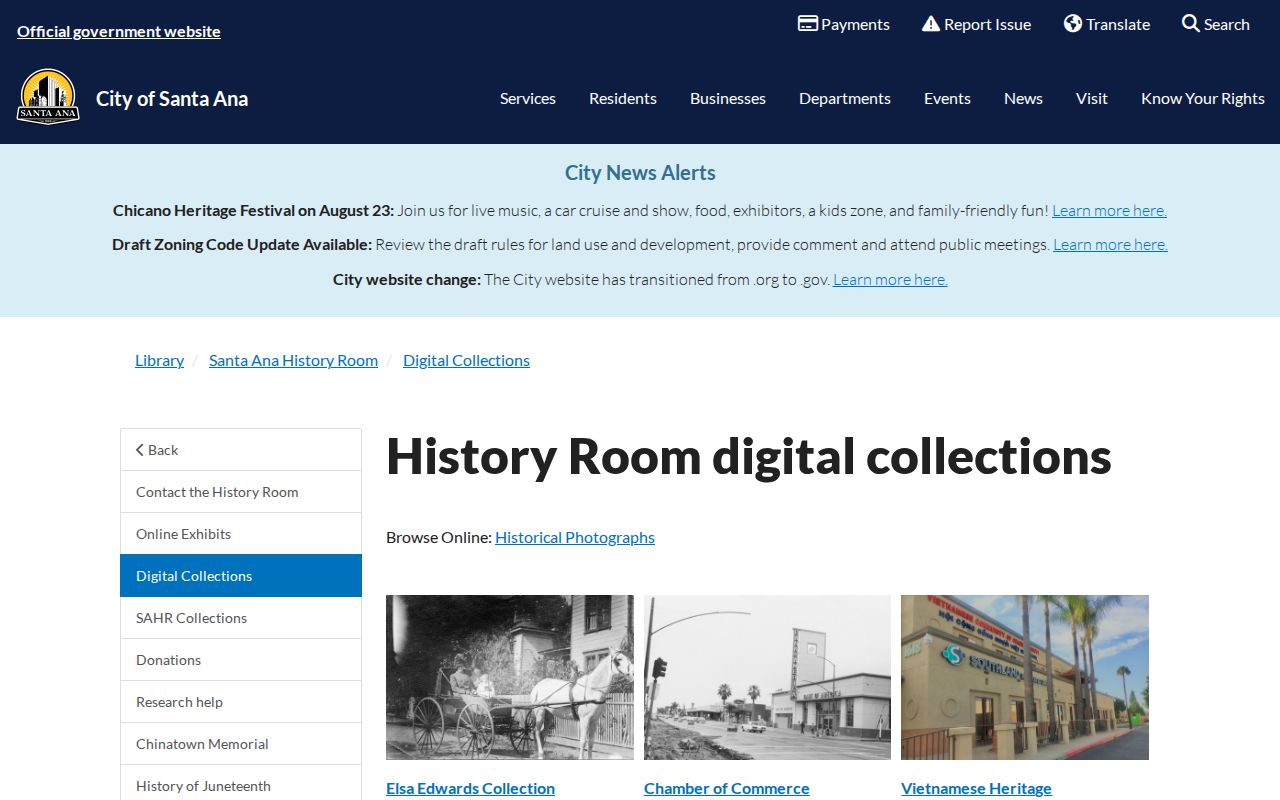
Use a photograph to test a street, building, or neighborhood story, then return to the dated directory and custodian records for names.
Tracing Santa Ana Families Across Years
A Santa Ana city directory works best when each entry serves a stated question. Family history may need a relationship; a house history may need an occupant sequence; a former classmate search may begin with a yearbook, then move to a directory or obituary. Dates and source notes matter more than one name match.
- Start with the earliest known name, address, spelling, and year. Record initials and honorifics exactly.
- Check the alphabetical listing, then the criss-cross section when an address is known. Note every move.
- Pair directory years from 1901-1950 with public decennial census households to test relationships and occupations.
- Inspect newspapers, deeds, permits, Sanborn sheets, probate, or an obituary when a name disappears.
- Mark gaps and uncertain links. Do not turn a missing listing into a death, move, or new household without another source.
The History Room holds Orange County census material for 1860-1910, and public federal releases extend through 1950. A directory fills years between census snapshots; a census may identify children or relationships omitted from a directory. The National Archives guidance sets release expectations before a later clue is checked with its custodian.
Santa Ana City Directory Name Clues
Historic-register reports are practical Santa Ana research leads. City packets combine directories, permits, construction costs, occupations, civic affiliations, and source notes for named properties. The Cartwright, Hamilton-Schoppert, and Rogers-Mansfield reports show how a resident story comes from several records, not a directory alone.
The Santa Ana Historical Preservation Society adds the Howe-Waffle House museum and local-history links. Its gateway gives building and neighborhood context, while the History Room and Archives remain the primary custody points.
The visual context can place a directory entry in Santa Ana's civic geography while the identity claim stays tied to a dated source.
Santa Ana Directory Research Timeline
The Santa Ana city directory record has a clear sequence of evidence and clear limits. Use the timeline as a research map, not as a promise of uninterrupted publication.
- 1901: the verified directory evidence begins in the local and HABS research trail.
- 1905-1962: selected alphabetical volumes support names, addresses, occupations, spouses, and household clues.
- 1949-1960: the Freeman report uses a focused directory run for a property history.
- 1961-1979: the documented city-directory gap calls for deeds, permits, newspapers, maps, and census evidence.
- 1980-1998: criss-cross volumes provide address-first evidence, sometimes without a named occupant or owner.
- 1999-2008: later directory evidence reaches the last volume identified in that local report.
No complete publisher sequence, shelf inventory, or digitized run was located in the research. The most reliable next action is a direct question to the History Room, followed by a visit to Orange County Archives when the needed material is county-held. That is how a Santa Ana city directory search stays accurate when the surviving record is uneven.