
Santa Ana Previous Residents by Era
One address needs a source sequence, not a single lookup. The era table separates title evidence, named occupants, household counts, building history, and archival context. The verified years are selected local evidence from Santa Ana reports and the History Room record, not a promise that every volume survives or that every year contains the same fields.
| Source | Years It Covers | Where Held | What It Shows |
|---|---|---|---|
| Recorder index and deed books | 1982 forward online workflow; pre-1982 references | RecorderWorks, Santa Ana counter, ordered copies | Owners, parties, dates, legal descriptions |
| Alphabetical city directories | Selected verified years from 1901 through 1962 | Santa Ana History Room and cited local reports | Names, occupations, addresses, spouse or co-resident clues |
| Criss-cross directories | 1980-1998 | History Room and historic-property reports | Address-first entries, sometimes without a name |
| Later directory evidence | 1999-2008 in one local project | History Room source cited by the City report | Later owner or occupant continuity where reported |
| Federal census | Public nationally through 1950 | National Archives and library access | Household members, relationships, occupations, residence |
| Sanborn maps and permits | Local editions from 1885 through later project dates | Library of Congress, city files, History Room | Structure, use, numbering, construction and alterations |
Start with the APN and a current owner when the goal is title. Start with a directory or census year when the goal is a household. Use permits and Sanborn maps to test whether an address, building, and name belong in the same time period.
Start Santa Ana House History With the APN
The parcel is the anchor for previous residents research. Locate the street address in the Santa Ana GIS Assessor Parcels layer, record the APN, inspect the parcel shape, and read the legal-description clues. Then compare the assessor’s situs address with its mailing address. Situs is the physical land location; mailing is where correspondence goes. A mismatch may describe a remote owner or representative, but it does not name an occupant.
The APN helps when an old street number changes or when a parcel is divided. A legal description can link an older deed to a later map through tract, lot, or block language. The Orange County Assessor property gateway is the next stop for ownership and assessment detail, with a public-counter fallback when the linked interface does not answer the question.
Keep three timelines separate: ownership, occupancy, and construction. A seller may have owned land while another household lived there. A permit applicant may be a contractor. A later directory may list a resident but no deed party. That separation is the key to identifying previous residents without overstating what any one record proves.
Walk the Orange County Deed Chain Backward
RecorderWorks is a free discovery index for recorded documents, not the deed image itself. The county instructions say staff will not perform the search for a caller. Use the parcel and owner clues to conduct a narrow name search, then order the document that can be read and checked.
- Write down the current assessee, APN, situs, mailing clue, and legal description before opening the recorder search.
- Search the current owner as a grantee within a focused date range and compare the parties, recording date, and instrument number.
- Order the acquisition deed, read the grantor, and search that seller as a grantee in an earlier window.
- Repeat the grantor-to-grantee step while the legal description and parcel continuity still match.
- When the electronic index no longer reaches the needed era, move to the Santa Ana office’s microfiche or deed-book references.
- Grantor and grantee
- The grantor transfers an interest. The grantee receives it. A former owner can be a grantee on one deed and a grantor on the next.
- Chain of title
- The linked sequence of recorded transfers that connects a present interest to earlier parties and legal descriptions.
- Legal description
- Survey-based land wording, such as tract, lot, and block, used to identify the land when street labels are unstable.
For a current address, the Santa Ana street directory supplies the broader address-keyed path. Previous residents research should keep the deed chain as its own backward trail.
Santa Ana Records Before 1982 Use Microfiche
The county’s online grantor-grantee workflow covers January 4, 1982 forward under the current access instructions. Earlier index work moves to microfiche at the Santa Ana office. A pre-1982 search therefore begins with the book, page, and instrument reference when one is available, rather than assuming the modern search box contains the older entry.
The free index gives discovery information. It does not display deed images, all vesting language, signatures, or the complete legal description. For a readable copy, use the recording identifier and the county copy process. The official copy instructions explain the counter and mail routes, including the need to supply useful identifiers and the option to request a certified copy.
Older deed work separates the index, microfiche, map, and copy stages. Preserve exact names, instrument numbers, dates, and legal descriptions. If a chain breaks, check a deed, subdivision map, permit, or archive before calling the earlier owner absent.
Modern Recorder Numbers Need Year Plus Six Digits
For 1982 and later records, the county’s working identifier is the recording year plus a six-digit instrument number. That format is more useful than a street address alone when an address has been renumbered or a common name returns many results. Match the year, number, party, type, and legal description before ordering.
The Orange County official-record copy page also states the copy cost: $1 per page plus $1 certification per document or map. The Clerk-Recorder fee schedule is the live reference for other charges. Mail requests need a self-addressed stamped envelope, and checks are made payable to County of Orange. A free index hit is therefore not the same thing as a paid certified record.
The capture below separates discovery from evidence.
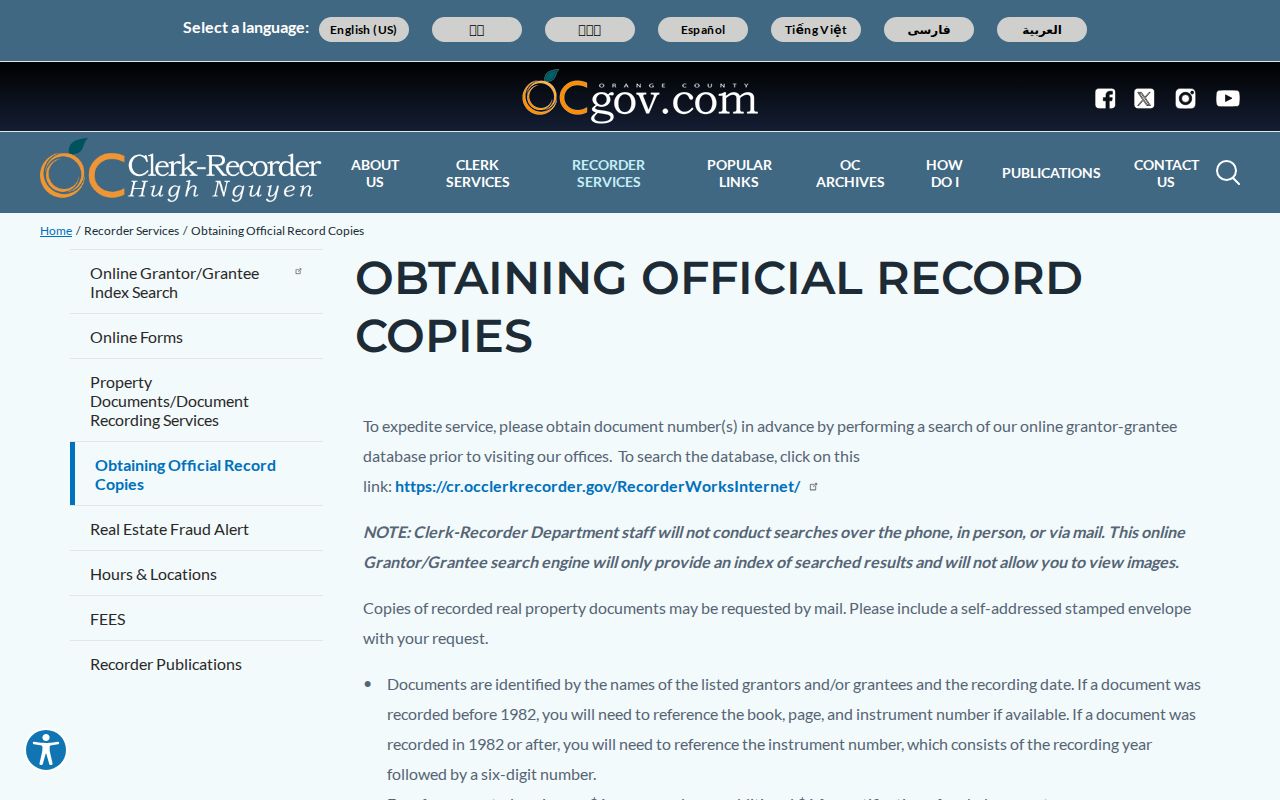
The image points back to the custodian’s copy instructions. Use the official identifier before paying for a reproduction or relying on a mailed solicitation.
Directory Years and Santa Ana Gaps
Santa Ana directory evidence is rich but uneven. The HABS bibliography documents used years including 1901, 1905, 1910, 1913-1914, 1915, 1916-1917, 1918, 1920, 1922-1929, 1931-1933, 1935-1941, 1945, 1947, 1954, and 1962. A local report for 1607 N. Freeman Street uses city directories for 1949-1960, reports a 1961-1979 gap, then uses criss-cross directories from 1980-1998.
The reverse run is not a guaranteed household list. In that documented example, the address appeared during the criss-cross period without a named occupant or owner. Later directory evidence covered 1999 through at least the 2008 volume for that project. The Santa Ana Directory Book explains the collection context; the previous residents trail uses those volumes only where the address and year support the conclusion.
When an entry is blank, record the blank. It tells the researcher to change channels rather than repeat an address search. Deeds, permits, census schedules, newspapers, probate, or an obituary may fill the gap, but none should be treated as a silent replacement for a missing directory line.
Pair Santa Ana Past Residents With Census Households
The federal census supplies a household layer that deeds and directories do not. Public federal schedules reach through 1950 under the national release rule. A census entry can show members, relationships, occupations, and a residence, but the address may be written by enumeration district or nearby landmark rather than in the modern form.
- Choose a directory year close to a census year and copy every name, initial, occupation, and address clue.
- Search the census household by surname, given-name variants, relationship, and local street or district.
- Compare the household with the directory’s occupants, then test the match against a permit, newspaper, deed, or legal description.
- Mark a likely match as a hypothesis when the census uses a nearby cross street or the directory has initials only.
The National Archives 1950 census guidance gives the public access context for the latest released federal census. The captured page below belongs to that federal source, not to a Santa Ana resident roll.
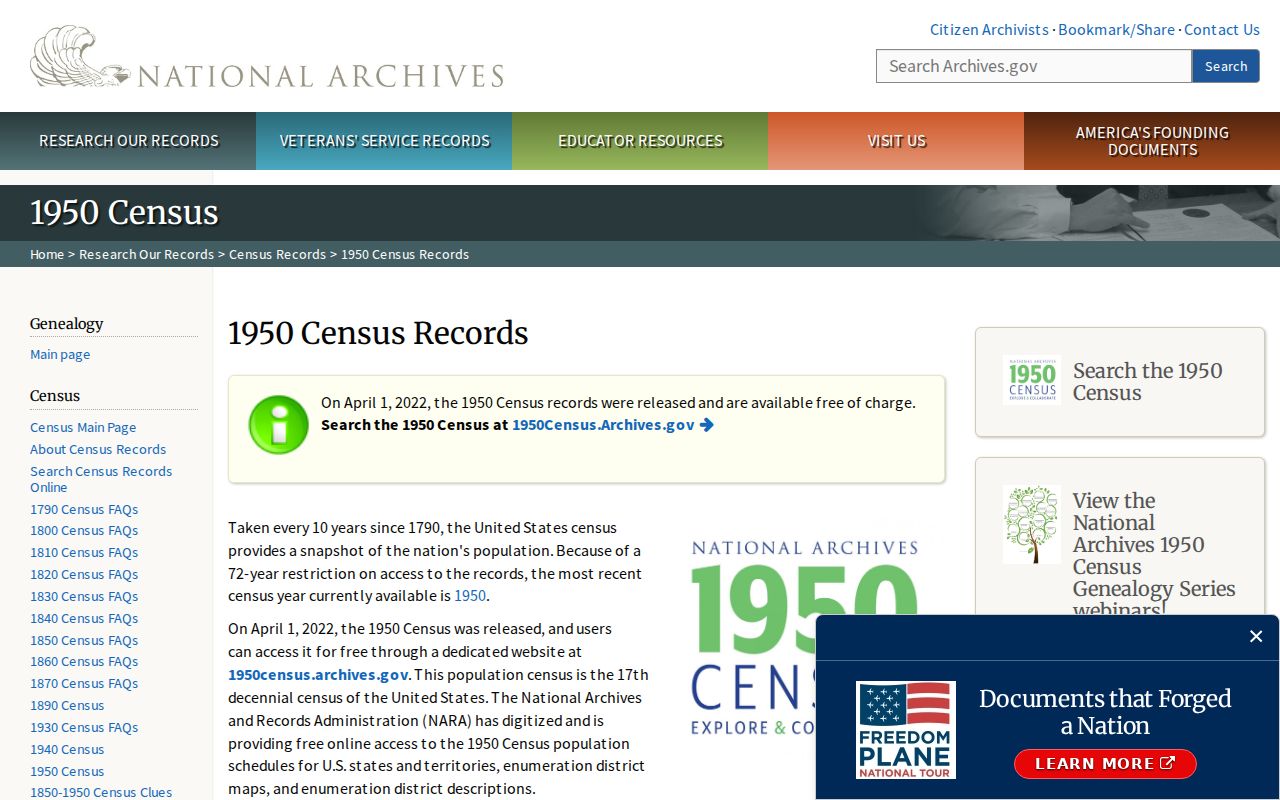
Use the census as a dated household snapshot. It can confirm a family-history lead, but it should not erase a directory gap or prove that every person stayed at the address.
Sanborn Maps and Permits Date a Santa Ana House
Sanborn fire-insurance maps describe buildings, uses, footprints, and street geography. Local evidence includes editions from 1885, 1887, 1888, 1891, 1895, 1906, and 1949, with the 1906 volume updated through August 1949. Maps do not name residents, yet they can show whether a structure and street pattern fit the date claimed by a directory.
Santa Ana Planning and Building records add permit numbers, applicants, contractors, project descriptions, valuation, and inspection milestones. Historic-property reports used those files beside directories and maps. A permit applicant can differ from an owner or occupant, so the record is a construction clue rather than a household roster.
The Orange County Archives holdings page shows the county repository that supports historic property research. Its Old County Courthouse location holds historic property and vital material, directories, newspapers, photographs, and government collections. The image below marks the archive channel used when a modern web index ends.
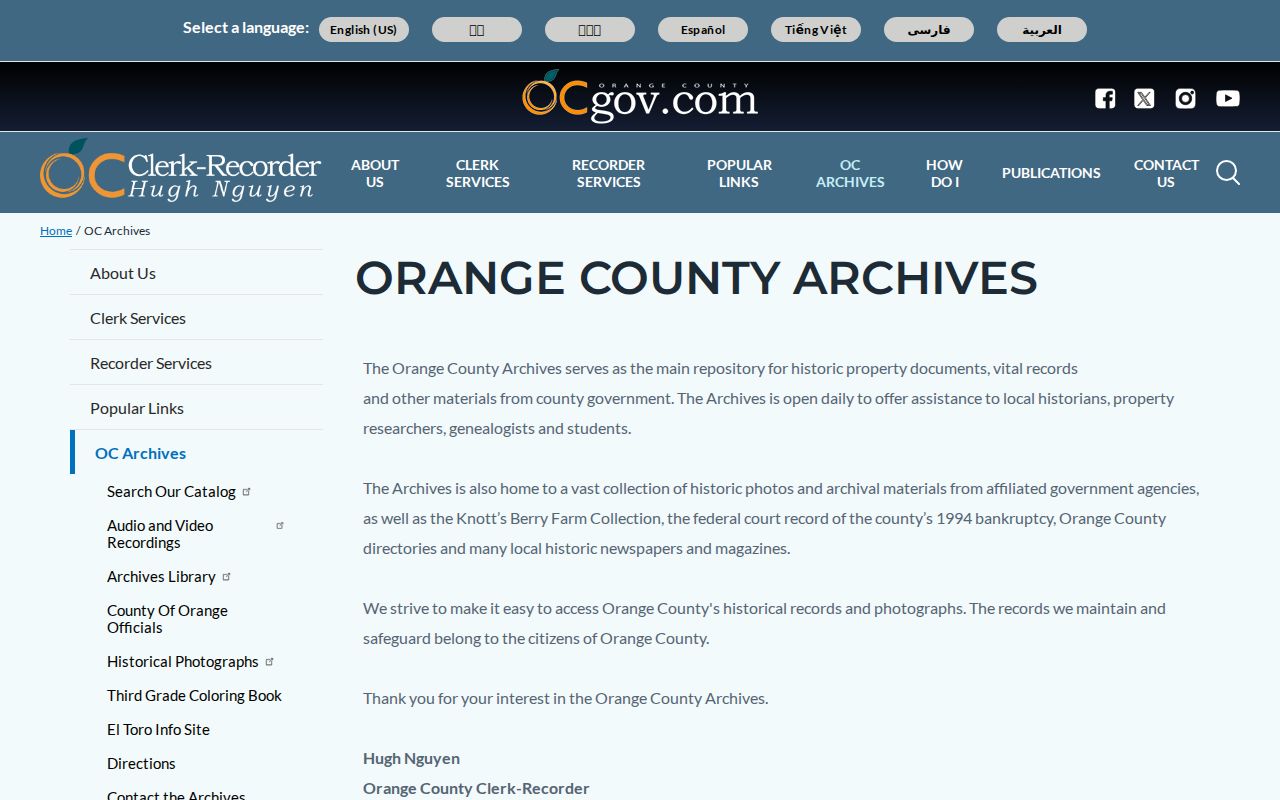
Archive material can supply context, but every named occupant still needs a cited source and a date. A map can date a building while a directory dates a person.
Probate, Obituaries, and Address Bridges
When a directory stops, a death notice or probate file may explain the next step in a family trail. An obituary can connect a former resident to relatives, a former address, an occupation, or a later community. Probate records can name an estate representative, heirs, or counsel. Use the Orange County Superior Court case-access gateway for public case routes, and treat restricted filings as a lawful endpoint.
Address bridges are strongest when several clues line up: the same spouse or co-owner, a matching occupation, a legal description, a dated permit, or a newspaper notice that names the street. Spanish compound surnames, married-name changes, initials, omitted accents, Anglicized given names, and Vietnamese name order can all affect a Santa Ana search. Preserve both surnames and search variants without merging same-name people by guesswork.
A historic-register packet can be a strong lead. Santa Ana reports trace surveyed-house occupants through permits, directories, maps, and later records. Check the underlying source rather than copying a report’s conclusion.
Lawful Santa Ana House History Needs Limits
Previous residents research is a personal-history and property-history task. It can support genealogy, an heir trail, preservation work, or a careful effort to reconnect with a former classmate. It cannot guarantee a complete list of everyone who stayed in a home. Renters, household members, utility customers, protected participants, and sealed-case parties may not appear in public sources.
House-history boundary. Use public Santa Ana records for lawful personal research, keep source dates and uncertainty visible, and stop when a protected person’s safety or a sealed record is involved. Do not use a previous residents search to stalk, harass, intimidate, or expose anyone.
The Orange County Clerk-Recorder’s property-fraud notice report is a useful final caution. Verify a document number and fee with the custodian before responding to a notice or paying for a copy. The image below shows why the official office, not a sales letter, should be the source of record.
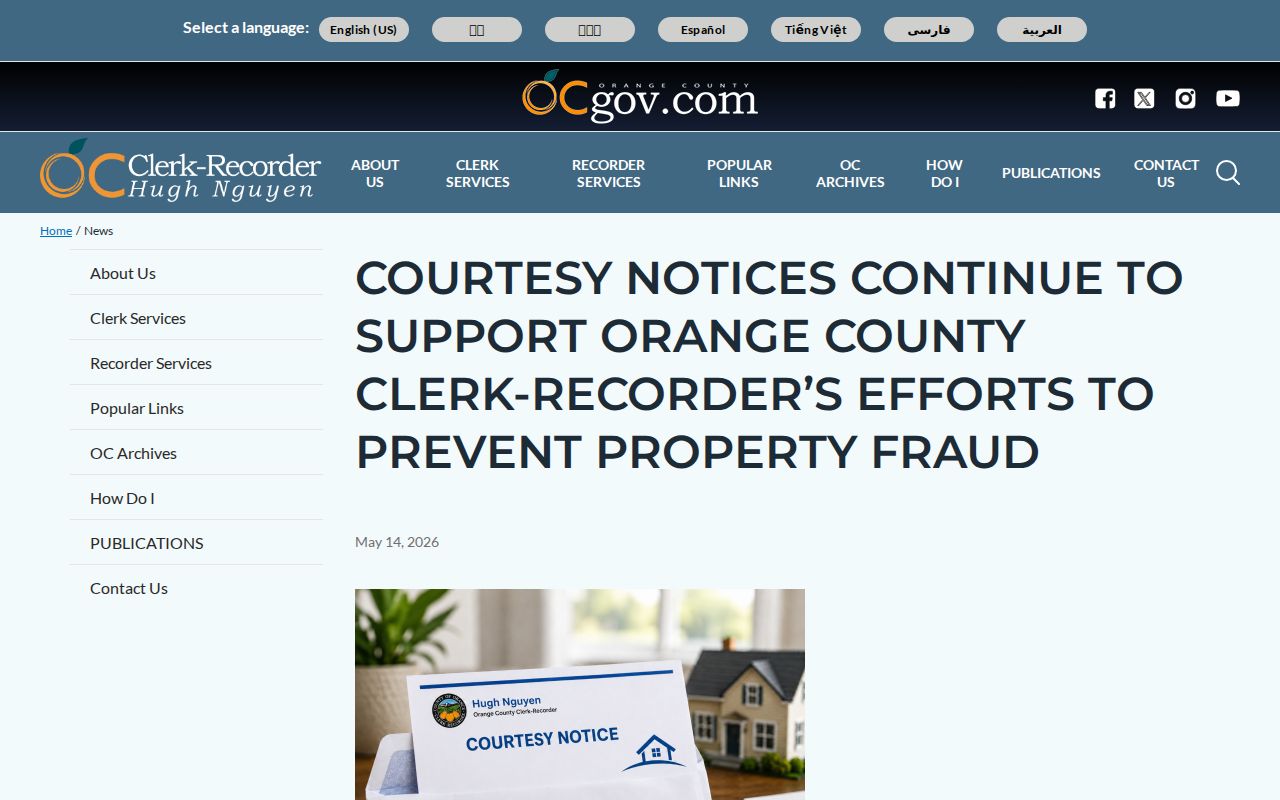
A careful trail may end with an uncertainty note. That is a sound result: the source has been checked, the gap is named, and no person has been assigned to an address without support.